Resources
Search below for resources covering the intersection of climate engagement, social science and data analytics.
RESULTS
Notable research of 2023
Inflation Reduction Act
Behind the scenes of Sunrise’s volunteer-led phone bank program
In the spring of 2020, Sunrise Movement had a goal of making 300,000 phonebank calls on six congressional primary races. Sunrise decided to create volunteer teams to manage other volunteers, liaise with campaigns, set goals, and develop strategy. The volunteer leaders of these teams took on a level of responsibility and autonomy typically reserved for staff. The team members took responsibility for setting goals, creating strategy and tactics, liaising with campaigns, and managing the work of thousands of other volunteers.

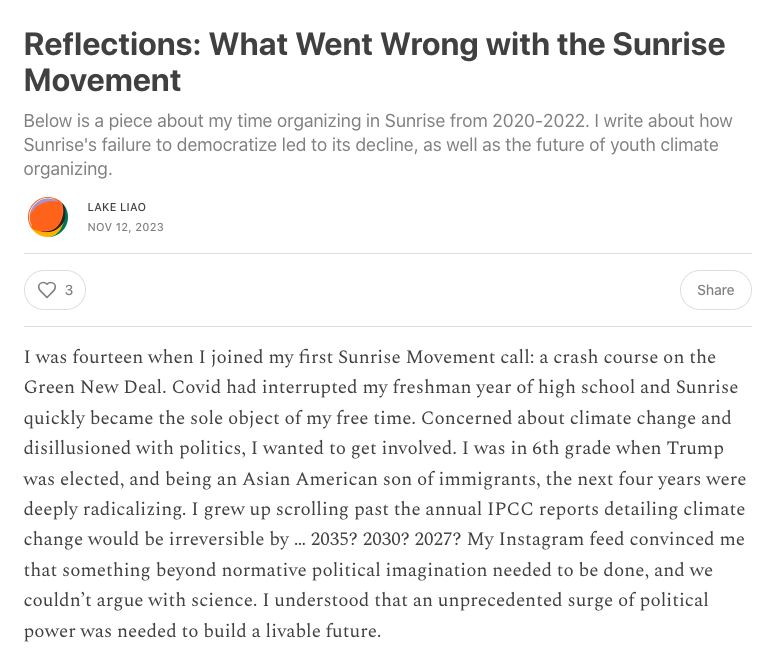
Reflections: What Went Wrong with the Sunrise Movement
The Sunrise Movement has had successes but also experienced internal difficulties. This article, a personal reflection on Sunrise experience, argues that the energy and mobilization of the 2018-2020 years that led to a surge of youth joining the Sunrise Movement won’t be possible in the next four years unless a new organizational strategy is built in the youth climate left. This author organized with a local Sunrise “hub” and then joined national leadership teams. However, Sunrise internal politics were based on who you knew.
Funding a Clean and Equitable Energy Transition: Lessons from California
California has been investing in a clean energy transition for decades, and, in recent years, has increasingly targeted funds to under-resourced and marginalized communities. Other states and the federal government have likewise stepped up. There is much to learn from California’s considerable experience. Our report series analyzes California’s decision-making structures — the processes that determine priorities and the mechanisms that turn broad justice principles into action. Our analysis and recommendations are intended to improve California’s programs, help emerging state programs consider the strengths and weaknesses of California’s institutional landscape, and influence emerging federal funding mechanisms.

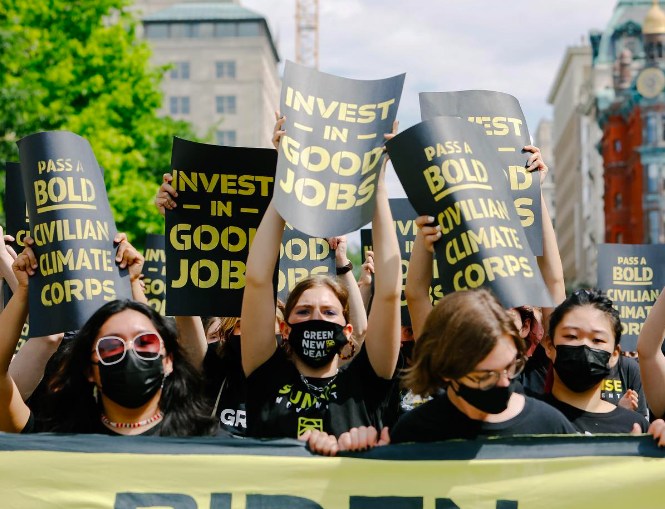
How climate activists won the American Climate Corps
Last month, President Joe Biden announced the launch of the American Climate Corps, or ACC — a program that will train some 20,000 young people in careers in climate and clean energy. In this resource, Sunrise Movement co-founder Evan Weber discusses the years of Green New Deal organizing that led to the landmark new jobs program to address the climate crisis. A broad paint brush of tactics contributed to the win that is the American Climate Corps. These tactics included 500 young people getting arrested for blocking the White House in the summer of 2021 while demanding a fully-funded civilian climate corps in the Build Back Better negotiations. They also included behind-the-scenes lobbying and policy negotiation, coalition building and the electoral work that delivered some of the highest youth voter turnout in modern history — with climate being the reason that happened. The latter is also the reason President Biden went more aggressive on climate and updated his climate policy.
Blueprint for a Multiracial, Cross-Class Climate Movement: The Workbook for Coalitions
This workbook is meant to help you translate the analysis and recommendations we provide there into workable features of your organizing. Whether you’re currently involved in a multiracial, cross-class climate coalition, thinking about starting one, or evaluating a past coalition on reflection, we hope this workbook clarifies for you and your coalition partners the breadth of considerations and decisions you should be prepared for.
Blueprint for a Multiracial, Cross-Class Climate Movement: The Report on Coalitions
Multiracial, cross-class (MRXC) coalition-building is essential if the climate movement is serious about tackling the climate crisis at the scale it demands. However, a historical lack of collaboration, trust, or healthy mechanisms to deal with conflict often impair those efforts. This Blueprint report and accompanying workbook provide an analysis of the difficulties MRXC climate coalitions are likely to face and offer recommendations for a proposed path forward.
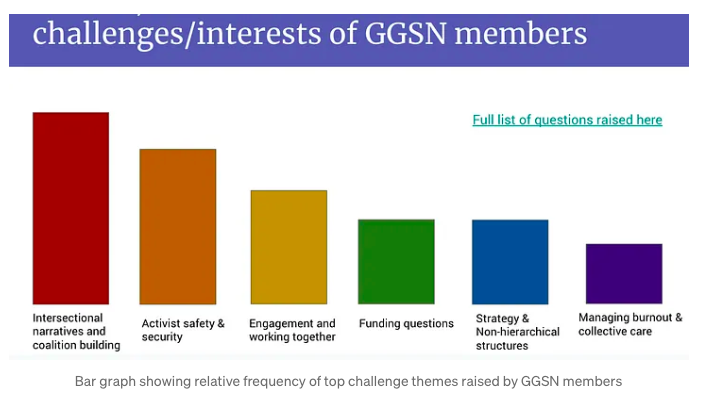
The emerging picture of the most-often cited challenges grassroots groups are facing currently includes: 1) Help with building intersectional narratives and coalitions to link struggles together; 2) Activist safety & security in repressive environments; 3) Maintaining activist engagement and working together efficiently in groups; 4) How to secure funding for grassroots organizing and how to report impact; 5) How to build effective strategy within non-hierarchical structures; 6) Managing burnout among activist communities & collective care. The Global Grassroots Support Network is a collection of 84 seasoned grassroots organizers, campaigners, coaches and more. The Network supports struggles for climate justice, reproductive justice, LGBTQIAS+ rights, housing justice and workers’ rights. These members currently come from: Australia, Canada, Denmark, France, Germany, Ireland, Kenya, the Netherlands, New Zealand, Nigeria, Spain, Tanzania, Turkey, Uganda, the U.S., UK and Zimbabwe. If you’re excited by the mission of supporting grassroots justice-oriented activists, the Network has lots of room for new members and you can commit the amount of time that is accessible to you, and the input that supports your mission.
The Kernel: A Tool for Developing Good Strategy (and Avoiding Bad Strategy)
The Sunrise Movement successfully relied on the “strategy kernel for campaigning.” The kernel involves three elements: a diagnosis that defines or explains the nature of the challenge, a guiding policy for dealing with the challenge, and a set of coherent actions that are designed to carry out the guiding policy. The Sunrise Movement used the kernel by convening the leadership team for a meeting to discuss each layer of the kernel; usually, a small team then took responsibility for completing the kernel, providing overarching direction for our shared work. In strategy work for movements, this resource’s author has been part of many conversations that began instead with deliberating the third layer of the kernel—the actions the group should take—and ended up spiraling into disagreement. The #ChangeTheDebate campaign in the spring and summer of 2019 is an example of how Sunrise used the kernel: Diagnosis—a central challenge is that the Green New Deal (GND) is polarized and presidential candidates are not talking about it because of the strategic narrative attacks from Fox/right-wing media; Guiding Policy—the movement must force presidential candidates to publicly and boldly talk about the GND in the media; Coherent Actions—launch the campaign will compelling visuals, host debate watch parties across the movement, catalyze a centralized mass action, birddog Biden and other candidates, and run a targeted, escalated action demanding time during the debate devoted to climate.
On the declining relevance of digital petitions
Digital petitions are a mostly-outdated tactic now. Both our politics and our media environment have moved in directions that render them less useful. Where petitioning used to be the central tactic in a digital campaigner’s toolbox, the Trump years saw a rebirth of collective, place-based mobilization. They were years of record-setting marches and participatory local-level civic engagement. Plus we’ve seen a renaissance in union organizing these past few years. But still, the relevance of petitions has diminished—related to the pervasive sense that government officials no longer behave as though listening to and representing citizens is a core part of the job. And it’s a reminder that most of our digital behavior is downstream of a small handful of quasi-monopolistic companies. If American Democracy is going to make it through the next decade, we are going to need better elites. I suspect, if that happens, we will happen to see digital petitions make a comeback. In the meantime, campaigners will do the best with the tools they have available—they’ll develop tactical repertoires that fit the changing media environment and respond to the political opportunity structure.