
Emerging Misinformation Threats – December 2025
Author: Justin Rolfe-Redding
December 10, 2025
Evidence-based communications guidance for the clean energy affordability and battery storage debates
Introduction
The landscape for clean energy buildout in the US has changed dramatically in the last year. Yet one constant is the ongoing barrage of mis- and dis-information1 from a variety of actors, from industry-backed anti-wind front groups to the President. The narratives and debates continue to evolve, however, and this report collects relevant research and insights from practice from the past 12 months, to provide guidance for anti-disinformation practitioners on two key emerging topics in the clean energy information space:
- Affordability: electricity costs and clean energy
- Battery Energy Storage Systems (BESS)
This report serves in part as an update to the broader clean energy misinformation literature review the Climate Advocacy Lab completed in 2024, Everything We Know About Combating Narrative Threats To IRA Rollout.
- 1For the purposes of this report, these terms will be used interchangeably, as will “clean”/”renewable” energy.
Affordability

Affordability Overview
It is no surprise that the cost of living is front of mind for many Americans at this moment, with 76% agreeing we are in a “cost of living crisis”. And with electricity rates spiking in many places and causing budget stress, fossil fuel companies, utilities, and some politicians have put clean energy (policy) in the crosshairs as the reason, despite research showing that renewables growth is mostly not to blame for electricity bill increases (and in fact renewables are lowering bills in some states).
So, what do we know from recent research that will inform efforts to push back against this disinformation? While we have limited evidence related to specifically debunking renewable energy affordability disinformation, we have ample data on messaging that wades into the blame game, and on the belief landscape of affordability among the public, and their knowledge of what is and is not driving energy bills. This can highlight opportunities to push our message forward and also highlight vulnerabilities where we may need to shore up the public’s knowledge so that disinformation has less fertile ground to take root and spread.
Key Affordability Takeaways
- Many people have not fully made up their minds about what or whom is behind spiking electricity bills, but so far they are not falling for disinformation that climate and clean energy policy are largely to blame
- Clean energy is off to a good start with a reputation as cheap among many, but plenty of others are uncertain or need to be convinced
- Focusing on a simple “clean=cheap” message, with compelling specific proof points, is probably the best messaging strategy for the current affordability debates
Affordability Understanding is Hazy
It is important to appreciate that for many people, the complex utility and policy dynamics driving changes to their monthly utility bills are fairly opaque. Only 37% reported they understood “How your utility charges you for the energy you use” either “extremely” or “very” well”, with similar levels of understanding for the reasons bills vary month to month. Beyond individual bills, interviews in a coastal community with potential offshore wind development found widespread uncertainty about offshore wind. And in a reminder that basic definitions are not always commonly held, polling finds that a substantial proportion of people consider “natural gas” to be a “clean” form of energy. But all this can be seen as an opportunity, in which our communications can strengthen knowledge, clear up uncertainty, and prevent vulnerability to misinformation.
Good News: Clean Energy and Climate Policy Are Not Receiving Much Current Blame for Rising Costs
Climate change policy and wind and solar power are not top of mind objects of blame for most Americans when thinking about spiking electrical bills: in an open-ended national survey question about reasons for such spikes, only 2–3% of respondents mentioned climate, wind, or solar. In a similar open-ended question in yet another survey, blame for electricity costs was more likely to be placed at the feet of Trump and energy companies, while Biden was low on the list, even for Republicans (for whom solar was also infrequently mentioned). In that same survey, when asked what they thought about a statement claiming Congress’s clean energy rollback would raise prices, 62% rated it as ‘true’, with similar proportions agreeing that wind and solar power will lower rates, and that these are cheaper sources of electricity than methane gas. And in an even more direct test of whether the opposition’s disinformation is landing, an experiment found that those reading a message claiming renewable energy is “not reliable” did not change their beliefs about the ability of renewable energy to lower their utility bills. At the same time, many swing voters are not tuned into these debates at all: substantial numbers of them said it was new and surprising when they were told about opposition to clean energy by Trump, Republicans, and utilities (and the effect this was having on bills).
So, while opposition disinformation blaming clean energy for utility bill spikes does not seem to be broadly resonating at this time, there is still widespread uncertainty; and the views of many have not yet been fully formed, representing both an opportunity for education and a risk in the information space.
Many See Clean as Cheap (But Not All)
Pluralities Understand Clean Energy is Now Less Expensive
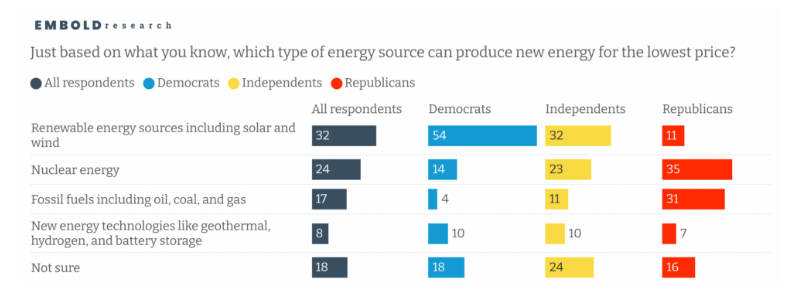
In a testament to the rapid decline in wind and solar costs in the last two decades, and efforts to educate the public about this, more people today believe clean energy is the cheapest form of new power than believe that about fossil fuels or any other source. 32% say so in one poll (vs. just 17% for fossil fuels). In another, solar and wind clearly stand apart as the two energy sources that voters believe are most affordable: 49% saying solar is first or second most affordable, wind at 45%, while ‘natural gas’ a distinct third at 34%. Similarly, cost competitiveness and the ability to save people money are now commonly seen as positives for clean energy, and a poll of several coastal states finds that a top reason to support offshore wind is price stabilization (with 35% agreeing), at the front of the pack with other popular concerns such as pollution reduction (35%), and energy independence (31%).
But the Glass is Also Partially Empty
The flip side of the coin of these promising numbers is that there still remains a substantial portion of the population that is not convinced that renewable energy is now the cheapest form. After all, pluralities are not majorities. And Republicans are less likely to think so. So, there is still room to grow public understanding. As one poll concludes, “Yet only about 1 in 3 voters (32%) know that renewable sources are now the cheapest way to produce new energy”; and while that is more people than think any other source is the cheapest, it still shows that “many Americans aren’t yet aware of the potential for large-scale investments in new solar, wind, and battery storage to drive down energy costs.”
Affordability Messaging
So, what is the best communications advice for tackling this mixed affordability belief landscape? We know from research several years ago that a message emphasizing the cost savings of renewable energy had a strong effect on support for renewable energy policy, among both Democrats and Republicans, and out-performed economy/jobs and global warming messages. The question is, does this finding hold up in today’s utility rate and political messaging environment? Recent research provides us with some promising insights that it still does.
Keep it Simple and Direct: “Clean=Cheap”
Sometimes the best communications advice is the most basic: providing clear, informative messages (repeated often) can provide the baseline of knowledge people need to navigate a noisy and confusing informational environment. In this case, research suggests that it is effective to state that clean energy is now the cheapest source of new power, backing that up with straightforward proof points. As noted above, despite promising levels of understanding among the public that clean energy is now the cheapest source, many still have not internalized this, and testing shows that effective messaging can have truly large effects at increasing this belief. We have not hit a ceiling yet.
Pushing this basic “clean=cheap” message is one of the central approaches of the Sierra Club’s Climate Truth Tellers anti-disinformation program, where they train their social media volunteers to focus on prices, affordability, and the message that “clean energy is cheaper and more reliable and more accessible”. And the data backs this up. For example, this educational statement was ranked among the top most ‘convincing’ and ’believable’ messages of 11 polled:
“Solar and wind farms only take one or two years to build, while gas power plants take six or more years and are far more expensive. And once solar and wind farms are built, they produce a lot of electricity for very little cost. A single acre of solar panels can power 80 homes, and just two turns of a wind turbine can power a home for a day. That’s why clean energy is already 50% cheaper than electricity from gas power plants.”
Similarly, a straightforward message about renewable energy’s ability to lower costs was the only message that actually worked to increase the belief that renewable energy can lower utility bills. Perhaps not surprising; but none of the other 10 tested messages could say the same.
Affordability Messaging Tips
Be specific: Without over-doing it on statistics, offer concrete proof points that tell the story or explain the magnitude of clean energy’s price advantage. For example, both the message above as well as the following (which 78% of people said was ‘persuasive’ to some degree) use the “50% cheaper” line: “The cost of solar and wind power is already up to 50% cheaper than electricity from fossil fuels, and solar and wind are far more reliable than coal or gas.”
Emphasize reliability: Positioning clean energy as a proven, reliable, established technology appears to be a key attribute to help people understand that it is inexpensive. So, the proof point that “Solar has come down 90% since 2003” may work not just because of the “90%” statistic, but also because the “…since 2003” phrase signals that solar has been around for many years and thus that it is now an established, mature technology.
Tread carefully in directly calling out disinformation: Whether to directly call out disinformation remains one of the trickiest topics in this field. On the one hand, academic research now concludes that backfire effects from debunking are generally not as common as once thought. However, it is still best to be thoughtful about proactively pointing out sources of disinformation, especially if the goal is to simply increase the belief that clean energy is cheap. One test found that a message warning that fossil fuel interests were spreading disinformation did actually backfire, making people less likely to believe that clean energy would lower their bills.
(Rooftop) solar is king: Solar (especially rooftop solar) is the ‘flagship’ form of clean energy, so focus on it in messaging if you have to choose between it and wind (which also does perform well, just not quite as well as solar); “solar & wind” also does well. More voters name solar (28%) as the cheapest source of energy today than name wind (17%); this is true for Republicans especially: a plurality see solar as cheapest, but wind lags behind both solar and methane gas for them.
Battery Energy Storage Systems
BESS Overview
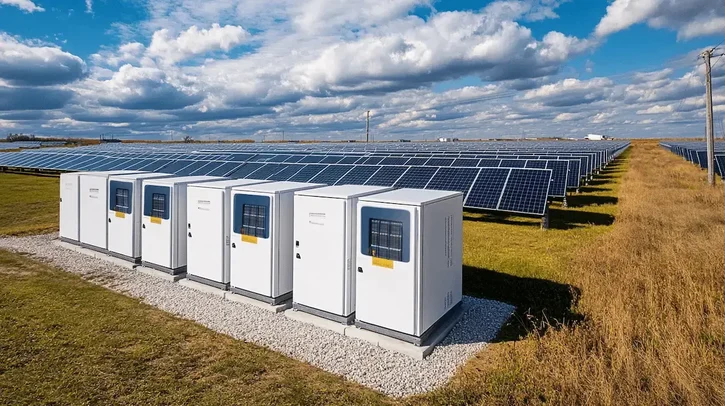
Battery Energy Storage Systems (BESS) are utility-scale (or, sometimes, home-scale) installations generally designed to collect excess electrical power when it is available, and release it back to the grid when demand exceeds supply. It is a rapidly expanding technology, which compliments the intermittent supply provided by wind and solar power. It is still early days in the public’s knowledge about this important technology, but misinformation about it is already spreading online1, so it is positive that our movement is beginning to learn the lay of the land of public views on BESS, and how we can respond to attacks. Research on the topic is still limited, however, so this section principally draws on two available studies, from GoodPower (a national survey and test) and Alliance for Climate Transition & Climate Advocacy Lab (a survey of Northeasterners). Both studies paint similar pictures of the state of play.
Key BESS Takeaways
- Most people are not very familiar with BESS, and are open to numerous arguments about it
- Most people are likely at an early stage of learning and thinking about this emerging technology, and over time opinions and knowledge could evolve
- There is not (yet) extreme political polarization around BESS
- This state of affairs holds both potential and risk for clean energy advocates
- 1Natasha Perez, Alliance for Climate Transition, personal communication
Low Familiarity with BESS
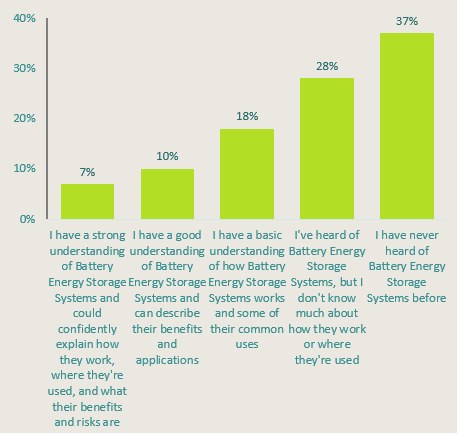
The available surveys concur that the public’s knowledge about battery energy storage systems is limited. For example, among Northeasterners, almost two-thirds said either they had never heard of BESS (37%) or they did not know much about it (28%). Only 7% reported a strong understanding.
Shallow but Widespread Positive Views
When a brief description of the technology is provided, national survey respondents tend to be supportive of BESS, with 77% in favor of installations in their community and 70% for federal investments. Variation across demographics was often minimal, and although Democrats showed greater support for BESS in their communities (85%), a strong majority of Republicans (69%) were also in support.
More specifically, strong majorities were in agreement with each of four statements about the benefits of BESS they were posed with, reagrding its potential to lower energy prices, increase jobs and revenue, increase grid reliability, and support intermittent renewable energy sources. That said, given the low overall awareness of BESS among the public, these results may best be interpreted as indicating that most people simply have a vaguely positive impression of the technology and an openness to believing information about its benefits, but not necessarily strong and firmly-held views on any specific points.
BESS Threats and Risks
As noted above, there is concern that the spread of misinformation about BESS is growing, especially online. And there is reason to think that such attacks may find receptive audiences.
Fire: Both surveys find worries about the potential fire risk of batteries, with 57% of the national sample very/somewhat worried. This number was slightly higher (66%) among Californians, where the Moss Landing BESS fire received coverage. In open-ended responses, some from across the country mentioned rumors or stories they had heard about battery fires. This suggests that if further high-profile battery fires occur, BESS opposition could grow.
Environmental profile: Another potential attack surface is the portrayal of battery systems and their manufacture and materials as on-net harmful to the environment, a concern not without some merit. Polling suggests here again public attitudes are in an early stage of development, with a plurality (44%) unsure about the environmental effects of BESS, and smaller and about equal numbers seeing those effects as either positive or negative. Notably, environmental concerns over BESS were most pronounced among those with the most familiarity. So, again, these numbers could rapidly change as individuals are exposed to more messages about this emerging technology.
Information sources: To the extent that people are hearing about BESS, polling of Northeasterners indicates close to half are doing so at least partly online and via social media, where there is substantial potential for exposure to misinformation. Notably, mainstream media is much less commonly cited as a source of BESS knowledge. This suggests we are in an informational landscape where BESS misinformation has the potential to spread in spaces that lack gatekeepers of accuracy.
BESS Messaging
Open season: A number of messages hold promise to increase support for BESS development. Statements about BESS’s advantages in terms of grid reliability, safety, lower costs, economic growth, energy independence, and support for intermittent renewable energy were all deemed persuasive by large numbers of people. Also, in randomized testing, both high production value videos featuring testimonials from renewable energy workers as well as simpler graphic explainer videos increased BESS support. This supports the notion that—with most people’s views on BESS yet to be fully formed—any positive messaging in any format may be effective.
Batteries as balance: Common themes that emerged from what people wrote in open-ended survey responses included the redundancy and reliability benefits of BESS. This suggests that there is a widespread preexisting mental model of batteries as reservoirs of power, which can provide backup and robustness to energy systems, and thus advantages for both individual home owners and the grid writ large. Messages that reinforce and extend these points could be a powerful messaging strategy that leverages that mental model and meets audiences where they already are—indeed, polling finds that providing people with an explanation of how BESS can help balance intermittent wind and solar on the grid also leads to increased support for clean power.
Batteries aren’t new: One framing that may be best to avoid is lumping BESS in with other emerging energy sources. A survey from Embold Research found that a package of “new” technology including BESS (“New energy technologies like geothermal, hydrogen, and battery storage”) was the least likely to be seen as the cheapest source of additional energy (compared to renewables, nuclear, and fossil fuels). Instead, position BESS as a proven, reliable technology that is a natural complement and component of renewable energy systems. The Grid Reliability Project’s message testing leads them, in fact, to recommend packaging batteries and renewables together, and that renewables should always be described as “wind or solar paired with battery storage” to address concerns about intermittency.
For now, accentuate the positive: The effect of fact-based rebuttals to common BESS myths have not, to our knowledge, received systematic empirical investigation, and so this messaging approach remains an area for future research. One partial exception was a statement presented to participants in the GoodPower polling, touting that the “BESS industry has a strong safety record”; this was rated as ‘convincing’ by most people, though somewhat less so than all the other statements with which respondents were presented, which focused on various benefits of BESS. This suggests that at this early stage of the public’s learning curve about this technology, it may be as, if not more, important to simply make the affirmative case for BESS and its benefits rather than playing defense, while also keeping an eye over the shoulder for growing misinformation and being ready to respond as needed.
Overall Conclusions
This review of the recent literature addressing key emerging topics in clean energy disinformation provides several lessons:
- Fertile ground: We benefit from a substantial wellspring of positive beliefs and support among the public on the topics of clean energy affordability and BESS benefits. Despite the incessant clamor of climate disinformation, we are not in a bad position as of now. And those in the public with less-considered or -informed views represent an opportunity for education and engagement.
- We know what to say: We have evidence-backed affordability and BESS messaging best practices to take advantage of these opportunities!
- Risks: But the landscape is not one in which we enjoy strong majorities across the board in terms of beliefs and issue support. And the opposition is highly mobilized, and in a position to take advantage of the looseness of many people’s views in order to feed them false or misleading narratives. The landscape could change quickly and unpredictably.
- We know a lot about what people think: Our movement has conducted quite a lot of polling on some of these topics, so we understand the public opinion landscape on clean energy affordability quite well.
- The state of opinion research on BESS is less well developed, but appears to be catching up fast.
- Gaps in our knowledge
- Tracking: We lack systematic misinformation tracking initiatives to keep tabs on emerging issues such as those addressed here. Is misinformation on affordability and BESS increasing, decreasing? What new topics, arguments, and strategies are emerging? Is our opposition abandoning old approaches and arguments, leaving us fighting the last war?
- To debunk or not to debunk? We do not have many direct tests of debunking or inoculating strategies that attempt to tackle misinformation head on, neither in ‘laboratory’ settings nor in the field, the latter of which would allow us to rigorously evaluate how effective anti-misinformation campaigns actually are.
- Getting on the same page: The research literature suffers from several conceptual/definitional inconsistencies that render comparisons across the evidence more difficult. This occurs when, for example, different studies use ‘affordability’ or BESS to refer to either home systems (solar panels and battery storage) or utility-scale installations. Or the failure to distinguish between the cost of energy at the societal/grid level vs. the effect on utility bills for individuals.
A big thanks to those whose consulted or whos work was drawn upon in producing this report, including Jessica Jewell (Water Hub), Hillary Larson (Sierra Club), Dahvi Wilson (Siting Clean Collaborative), Maddie Walsh (Bantam Communications), and KyungSun Lee (Climate Advocacy Lab).