
November Insights
EVERYTHING WE KNOW ABOUT COMBATING NARRATIVE THREATS TO IRA ROLLOUT
Introduction
The potential climate success of the Inflation Reduction Act is premised upon a rapid and widespread buildout of renewable energy generation and adoption of clean technologies such as EVs. But this progress is threatened by growing skepticism, concerns, misinformation, and disinformation, and resistance to these developments.
This month’s Hub report is a literature review covering what we know and don’t (yet) know on combatting negative narrative threats, and the guidance we can draw from recent available research. We have collectively learned a lot about the evolving landscape of mis/dis information since we last wrote about this topic in early 2024. As we head into 2025, we offer our insights on the opportunities ahead to fill the gaps in our movement’s understanding. Beyond the empirical research, we also include a section at the end of this report listing other tipsheets and guides that offer common sense messaging advice and factual rebuttals to misinformation.
You can also access these resources and more on our IRA Narrative Threat Resources roundup page, which we will keep up to date as we receive new resources.
To compile this review, we stand on the shoulders of others, both those who have created this body of research, and those who have rounded up and synthesized much of this same material. Thank you to everyone who’s contributed, particularly Maddie Walsh and Kitty Thomas at Drive Agency!
Key take-aways
- Misinformation and skepticism about renewable energy siting and EVs are widespread, as are organized efforts to spread them. Research to address this has likewise targeted many parts of the country.
- In addressing these issues, the messenger is key: Center authentic, real people, with experience, credibility, and connections to the audience.
- We know a number of pro-renewable energy messages that work consistently. These include emphasizing specific tangible benefits, and how renewable energy can help to maintain the beauty of rural areas.
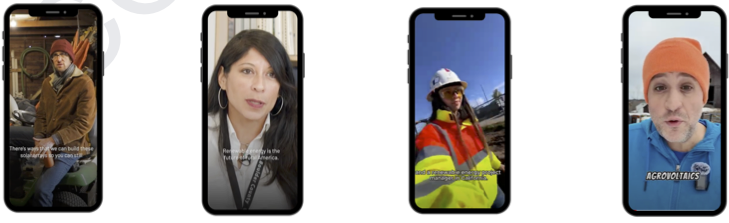
- Videos with a testimonial-style format are particularly effective.
- Research on directly countering negative narratives and beliefs on these issues is still developing, with some identified challenges and promising approaches.
- It is possible that in general, focusing on pro-renewable energy messages may yield better results than attempting to directly combat mis/disinformation.
- There are not stark patterns as to how different audiences and geographies respond. However, well designed messages about a given technology, targeted to rural people, are likely to build support for that technology in many rural parts of the country.
- Persuasion is often stronger among those most expected to be resistant, so our messages have a great deal of potential to depolarize these issues.
- Community benefit agreements offer a potential on-the-ground strategy available to organizers and developers to help address skepticism surrounding renewable energy siting.
Where is research most targeted to combat opposition and build renewable energy support?
This review includes 19 recent resources (polls, message tests, etc.) that specified some type of geographic targeting (4 more were nationwide in scope), all released in about the last year.
- Rural focus: Not surprisingly, given where large renewable energy projects are likely to be sited, the majority of resources (14 of 19) examined rural areas.
- Diversity: All told, 31 states and one Tribal nation were included across these studies. Many states were in at least 3 studies, with a handful included in 4 (or 5, in the case of Indiana).
- Regions most targeted: The Western region was most studied, followed by the Midwest and Midatlantic; New England and the South received the least focus.
- Localities targeted: A number of studies targeted specific counties or other localities with high potential for renewable energy development.
What messages & messengers are working? And for whom?
The following sections review the research on increasing support for renewable energy siting;
combatting opposition narratives; and electric vehicle messaging. For more specific talking points and recommendations, see the collection of messaging guides at bottom.
1) Increasing support for renewable energy siting
One of the richest troves of research focuses on how to increase support for local renewable energy siting and the beliefs that underpin that support.
- Well designed communications can move the needle: Multiple studies have found messaging that worked to increase support for and positive beliefs about renewable energy siting. For example, ACE has found an average 18 percentage point lift across various measures from 13 tests.
- The basics: Across studies, the common denominator of effective messaging was an emphasis on economic benefits and local, personal stories.
- The messenger is very important: A consistent finding (in these studies and much communications research) is that the who is as or more critical than the what of a message.
- Authentic messengers are key: Real stories from real people sharing their own experiences.
- Types of effective messengers: Farmers, local scientists (or other experts with no conflict of interest), county officials, union workers, and landowners with projects on their land or those living near existing projects.
- But those seen to have a vested interest in the issue are less trustworthy.
- Broad rural audiences
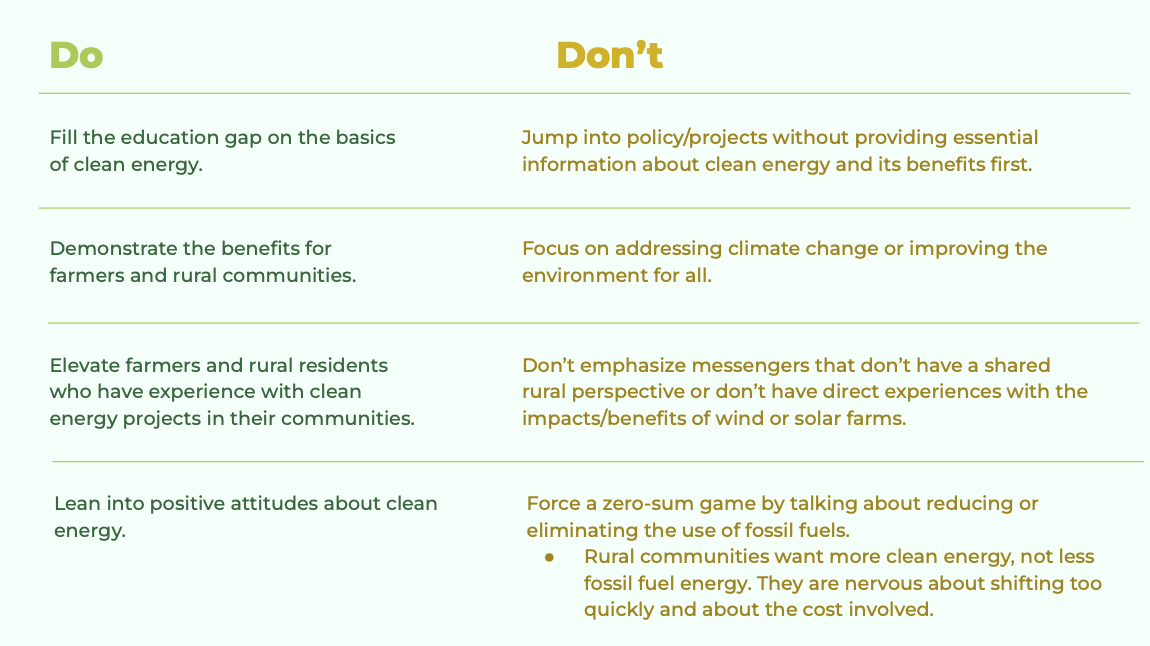
- Beauty: The following message is most effective with rural audiences across multiple tests of wind and solar persuasion: renewable energy development “keeps rural beautiful” – it preserves and boosts rural communities. Use (ideally local) specific success stories as proof points.
- Personal stories: To persuade people in states with renewable energy potential, use testimonial-style videos of personal stories of renewable energy’s positive impacts on rural communities.
- Solar audiences: To persuade people in states with solar potential, emphasize content with landowners discussing the benefits of solar energy.
- Conservatives respond well: We often see the largest persuasive effects with those whom we might expect to be least supportive (such as conservatives, Republicans, Trump voters) (with some exceptions). Though, this may be due to “ceiling effects”: other already-supportive groups may simply not have any room to become even more so.
- Regional differences? Little of the research we examined specifically compared different states or regions, so we are unable to make many strong conclusions about any differences in levels of support or message effectiveness by geography at this time.
- State-based results: Most studies targeted multiple states, so we have limited evidence on what works in specific states. That said, many of the themes that emerge from the single-state studies below may apply to many other states and regions as well.
- Indiana: Lower property taxes and electricity bills messages are most effective with priority development counties in Indiana. Republicans in rural Indiana counties were persuaded by messages about a diversified/balanced grid, jobs, costs/energy independence, and lower taxes.
- Rural Ohio: A “Rural Pride” message was a clear winner for the majority of residents of rural Ohio. An “Economic Impact” message resonated particularly well with younger respondents and those with very liberal views. These were both better than a “Way of Life” message.
- Rural Oklahoma: Local (especially personal) stories about wind presented in first hand testimonial-style videos were persuasive (though these same videos also performed well in other states)
- To localize messaging, or not?
- Local? Conventional wisdom suggests messengers and messages tailored to the audiences’ region or state will perform better; and there is indeed some evidence of a slight benefit from localized content.
- Don’t sweat it? Yet, as long as the content is strong and still relatable, the difference may be small when running an ad from one state in similarly rural areas of other states. This is reassuring, as it can be taxing to develop messages and messengers for every locality, and “the perfect shouldn’t be the enemy of the good.”
2) Combatting opposition narratives
We have unfortunately only a modest body of evidence on directly countering, debunking, pre-bunking, or inoculating against IRA & renewable energy mis/disinformation and negative narratives. See also our roundup of general guides to debunking (climate) disinformation.
- It can be tough: Inoculation against concerns that renewable energy will change the character of rural areas is hard, and messages to do so did not work very well in testing in Ohio and Georgia.
- …But can work: Some groups report success inoculating early with educational messages and in real-time head-to-head tests against opposition messaging.
- Reveal who’s behind the disinfo: Naming fossil fuel CEOs as the source of attacks against renewable energy successfully defanged them, in Ohio and Georgia.
- Not just the facts: Don’t expect to effectively counterbalance misinformation with facts alone. Building a connection to the audience remains key, using shared values and trusted messengers.
- But best not to engage? Overall, unless there is a very specific circumstance or piece of mis/disinformation requiring a response, the best general practice may be to flood the zone with positive (pro-clean energy) messaging, indirectly inoculating against opposition messaging and denying it an uncontested space to spread.
3) Electric vehicles
To build support for electric vehicles and “pre-bunk” counter arguments, emphasize economic and environmental benefits, along with freedom of choice.
- Emphasize affordability: Tell audiences that EV costs are falling fast, and remind them of volatile gas prices.
- Highlight choice: Talk about the rapidly expanding lineup of EV models.
- Go green: It’s also still a winning message to underline how EVs reduce air pollution.
Negative narratives and beliefs about renewable energy siting
In designing efforts to combat misinformation and negative beliefs about renewable energy, it’s important to know the lay of the land.
- People like renewable energy: While renewable energy skepticism (notably in rural areas) is not uncommon, on balance general views of renewable energy are positive (if sometimes soft), and pro-renewable energy messages are often more effective than anti-renewable energy messages (though not always).
- …Just not here: But people have less support for siting renewable energy in their community.
- What benefits? Many rural people are skeptical that renewable energy siting will bring economic benefits for them.
- Fossils still needed: Many rural Americans are skeptical that renewable energy can meet 100% of our energy needs, hold positive views of fossil fuel companies, and believe that fossil fuels still need to be part of the energy mix.
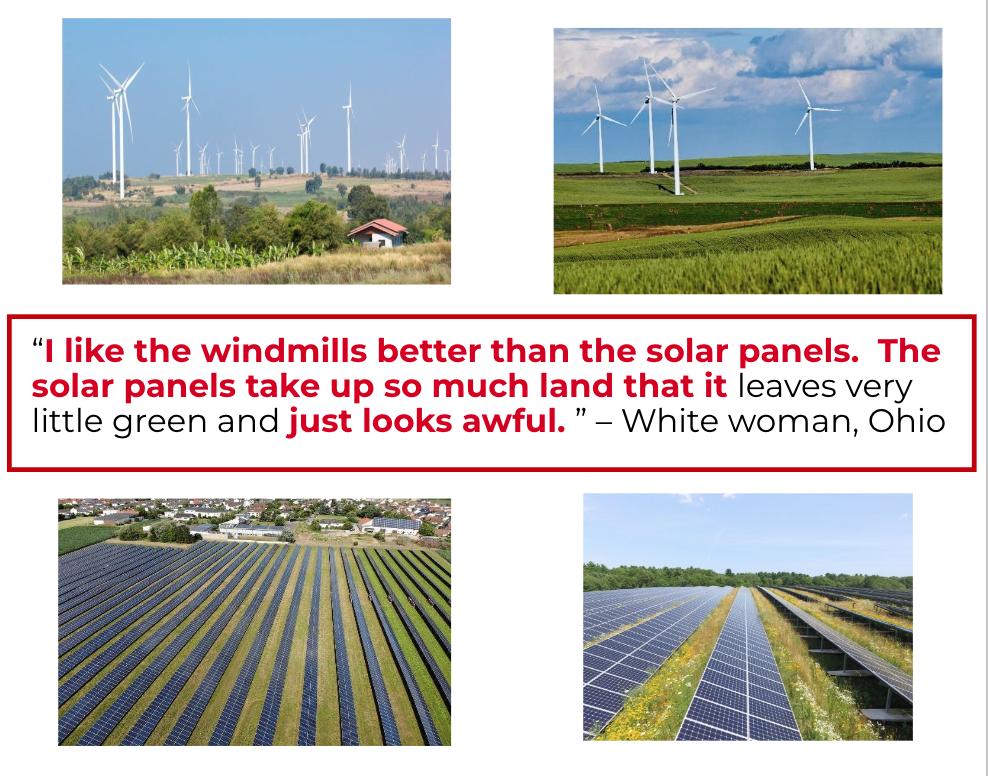
- Process and engagement matter: While some concerns around large-scale solar projects stem from beliefs about negative outcomes such as economic, environmental, visual, and landscape impacts, local residents also commonly have concerns about the project process, including around information provided to their communities, the community’s influence over project design, and the efficacy of the community’s efforts.
- The paranoid style: Around a quarter of Americans agree with contrarian claims about wind farms, and these views are related to belief in conspiracy theories and opposition to wind energy policy.
- Ray of sunshine: Solar leasing supporters in Appalachian counties see solar as a protector of farmland, by providing the financial means for farmers to continue farming, and prefer smaller-scale projects that fit into the rural landscape and community.
Community benefit agreements: Another way in
Not all engagement has to (or should) take the form of ‘communications’ and ‘messaging’. How renewable energy projects are designed—including legal procedures—can be important parts of the strategy. Enter, community benefit agreements1 (CBAs), which spell out what a developer provides to local residents and which can serve as loci for organizing and coalition building. Research in several communities offers insight.
- Why CBAs can help: As noted above, there is widespread skepticism around the benefits of renewable energy siting. Local residents can feel dismayed at energy developers because they believe developers had not fulfilled promises on previous projects, and that community engagement had been insufficient. Generic talk of benefits doesn’t work as well as specific, tangible benefits for a given community.
- CBAs receive a warm(ish) welcome: Acrossseveralcommunities, CBAs were viewed somewhat positively and the possibility of CBAs increased support for renewable energy projects.
- …But are no silver bullet: Skepticism remained that CBAs would actually provide benefits, and for many they don’t make a difference in their support for renewable energy.
- Best CBA actors: Farmers, small business owners and environmental groups were popular choices as negotiators of CBAs across the table from developers.
- 1We use this phrase to refer to project agreements generally, which can include community benefits plans (CBPs), Community benefits agreements (CBAs), and project labor agreements (PLAs).
Where is the opposition concentrating their efforts to spread disinformation?
Opposition messaging about wind and solar energy and EVs is happening around the country – particularly regarding offshore wind, with anti-renewable forces actively pursuing disinformation campaigns. For example, in one week earlier this year, renewable energy misinformation on social media included over 1,500 posts with at least modest engagement (mainly posted—and reposted—by possible bot accounts). Messaging regarding potentially hazardous effects of offshore wind has been prominent in California, New York, New Jersey, Delaware, and Maryland, among other states. Anti-wind and anti-solar development legislation has been introduced in states including Washington, Kansas, and Iowa.
Messaging Guides
The following are guides that suggest messaging practices or offer rebuttal talking points on various misinformation related to renewable energy and EVs.
- Renewable energy messaging guides
- “Local Siting Misinformation” (2024): Ways to respond to misinformation regarding the siting of renewable energy projects. For example, because opponents falsely claim that solar and other renewable energy projects kill coal energy jobs, respond with messages such as: “Solar projects do not kill energy jobs; instead, they create new opportunities for employment.”
- “Rebutting 33 False Claims About Solar, Wind, and Electric Vehicles” (2024): Addresses some of the most pervasive false claims, such as that solar panels leak toxics.
- Wind Turbines & Birds: Myths & Facts Uncovered (2024): Clarifies that other human causes contribute more to bird deaths than turbines, and that steps can be taken to mitigate turbine impact.
- EV messaging guides
- “Talking Points: EVs are Safe to Use During Emergencies” (2024): Push back on misinformation about emergencies and natural disasters in ways sensitive to the concerns and anxieties of residents in hardest-hit areas. For example, highlight the causal link between vehicle pollution, greenhouse gas emissions, and extreme weather events.
- “Talking Points: EVs are Fire-Safe” (2024): Push back against the narrative that EV battery fires are frequent, widespread, or difficult to predict or prevent. In reality, EV fires are rare, and are almost always caused by predictable factors (e.g., physical damage to the battery or saltwater flooding).
- “Electric Vehicles Challenges Rebuttals” (2022): When opponents say, “requiring a shift to electric vehicles requires more dirty mining,” respond with, “mining companies must operate with consent from the communities they impact.”
- Pushing back against common misconceptions about electric vehicles (2020): Short, fact-based responses to rebut some common misconceptions about EVs, such as claims of human rights abuses in the supply chain.
- “Rhetoric vs Reality Talking Points” (2024): Ways to respond to misinformation regarding electric vehicles (EVs). For example, localize your messaging with information about state- and local-level EV investments and job growth wherever possible.
Opportunities for research and the work ahead based on existing gaps
Based on this literature review, we note several topics that have been under-studied:
- Methods to directly combat opposition renewable energy narratives have received remarkably little study, and we could know more about effective approaches and insight into when and if it is advantageous to employ them.
- We need to learn more about how pro-renewable messaging fairs in real-world environments, where opposition messaging is also prevalent and counterframing effects are considered.
- What is the best persuasive messaging for non-rural audiences? So much of our message testing is focused on rural audiences, we do not know as much about other groups.
- We need more direct documentation of disinformation/opposition campaigns and their effects.
- As others have noted, “significant research looks at how to persuade audiences toward a more positive view of renewable energy projects but [there is] less analysis of the best way to move people to take action in support of a project.”
- How can we address concerns that renewable energy will change the rural character of communities?
- Are there state or regional differences in beliefs and attitudes, and the best performing messages and messengers?
- Research on community benefit agreements in a few communities shows their potential (but also limitations) in shifting support. How will they perform more broadly, and how can they be designed, negotiated, and communicated in a way to provide the most (equitable) benefits and engender the most support?
…And keep an eye out for next month’s IRA Hub report, which will include insights from the latest field research on combatting mis/disinformation, including a deep canvass project building support for offshore wind!
Connect With Us
If you are working on IRA communications, story-telling, and organizing efforts, we’d love to connect with you to see how we can support your efforts. We have a diverse array of free training, thought partnership, and coaching programs to bolster our movement’s efforts around the IRA. Reach out to KyungSun, Senior IRA Program Manager to learn more.
If you are running digital IRA ads, we’d love to partner with you to grow our community knowledge base of insights and trends emerging across IRA ads. If you’d like to learn more, reach out to KyungSun, Senior IRA Program Manager, and we’ll get the ball rolling.
Have other IRA campaigns, reports, or research work you want to share? Get in touch and we’d love to learn more about your efforts and get you connected with peers across our growing Lab community of 4,000+ climate advocates and researchers.
Additional Resources
Resource on combating IRA Narrative Threats
 Mis/disinformation and opposition narratives are a growing threat to the renewable energy rollout enabled by the Inflation Reduction Act. Check out the Lab’s new central repository of resources for advocates to push back. We round up rebuttal talking points, news stories, social content, poll-tested messaging guidance, and social science research. Find resources and contribute yours here.
Join the Clean Energy Storytelling Program
 The U.S. Department of Treasury’s Clean Energy Storytelling Program invites individuals, workers, businesses, tax-exempt organizations, and other eligible taxpayers to voluntarily share their stories about how the Inflation Reduction Act’s (IRA) renewable energy tax incentives are lowering energy costs for families, bringing back and strengthening manufacturing, and creating good-paying jobs across the country. The goal is to educate more Americans using some of the best examples around: stories from other people and organizations who are pursuing and benefitting from these incentives. Share your stories here.
Clean Economy Coalition of Wisconsin launches new IRA Resources Site
 As we continue to raise awareness of the IRA, the Clean Economy Coalition of Wisconsin is engaging Wisconsinites by creating a one-stop shop of IRA resources and success stories. Their website aggregates resources specific to farmers and rural residents, non-profits, businesses, and more, and highlights success stories of how other Wisconsintites are taking advantage of IRA’s benefits. Check it out here. Let us know if you have IRA success stories and resources pages for your community – we’d love to learn more about it!
Help Center
How Do I Get Involved?
The data and insights in this Hub gets better with more participation, and if you are here, the chances are pretty good that you’ve got something to contribute. There are a variety of ways you can get involved, from contributing ad data, to sharing reports you are creating with your own polling or focus groups. Let’s have a conversation about how you can contribute to our effort. Reach us by email here, and we’ll get the ball rolling.
Data FAQs
Wow, that’s a lot of data. You are probably curious about how we’re handling it and how we’re keeping it secure. We’ve got a document for you! Check out our data FAQ here.
Name Generator
We have created this name generator that can be used by those running ads to create file names for the ad data they are sending to us; doing so will provide consistent naming conventions that will convey to us useful information on the digital ads, enhancing in turn the insights we can offer back to you all.
- Why? Following discussions with others working on the IRA, there has been a demand for more in-depth analysis of ad performance based on multiple factors (like audience and message type). We’ve pinpointed the priority factors to measure, and this name generator will enable us to analyze them across all ads.
- Who is this relevant for? So we can collect the most extensive, useful and accurate insights, we would love for any organizations running ads (with any size budgets) to use the generator to name the files they send us.
- How to get involved? Simply duplicate this doc and follow the instructions in the guide and start generating your file names! If you’ve got questions, you can reach us here.