
Simple informative messages build support for rural clean energy policies – March 2025
March 10, 2025
Welcome to our first edition of the Clean Energy & IRA Hub Insights Report for 2025. Insights reports provide an in-depth look at the latest case studies and messaging and storytelling projects to educate and persuade the public on the benefits of clean and renewable energy for all.
This report is co-authored by: Justin Rolfe-Redding, Social Scientist, Climate Advocacy Lab
& Madeline McGill, Communications Director, Resource Rural
Background
Resource Rural has collected the personal stories of rural people across the country who have benefited from federal clean energy and infrastructure investment programs. They are preparing to feature these stories across press and social media campaigns, to build awareness and support for programs that invest in rural communities. They based their storytelling on past research and evidence-backed message frameworks, but wanted to refine and test the strength of their framing and language tactics before launching their press and social media campaigns. They wanted to know: Was their language resonating with rural audiences? Were they positioning people, places, and the government in a way that was relatable and centered on rural agency? In partnership with the Lab, they have first tested two framing choices: whether focusing on Economic Growth or Economic Stability was more effective; and whether focusing on Lasting Benefits or Risk of Loss was more effective.
Research Design
Two randomized controlled trials/tests (RCTs) were conducted: in each, participants were randomly selected to see a Resource Rural message, or a “placebo” control message unrelated to the issues in the test. Using the GrowProgress online research platform, participants were recruited from rural ZIP codes in the US, and pre-screened for their ideology, with only those with broadly moderate views (from “slightly liberal” to “slightly conservative”) included in the tests. Following exposure to the messages, respondents answered three questions (see appendix) assessing support for rural climate and infrastructure policy. Results were weighted by age, gender, race, and education to be representative of the broader population. Data were collected in late March 2025. The total sample size across both tests was 3,982 (approximately 664 participants per message condition).
The tested messages each contained text and a graphic, describing benefits of a federal infrastructure or clean energy program, and were in English only:
- Test #1: Growth vs. Stability
- Message A: Framing the benefits of the Bipartisan Infrastructure Law in terms of new economic growth
- Message B: Framing the benefits of the Bipartisan Infrastructure Law in terms of stabilizing the economy
- Test #2: Benefits vs. Loss
- Message A: Framing a rural small business energy program in terms of the benefits of maintaining the program
- Message B: Framing a rural small business energy program in terms of the downsides if the program were eliminated.
See full messages and other design details, and complete results for the Benefits/Loss test and Growth/Stability test.
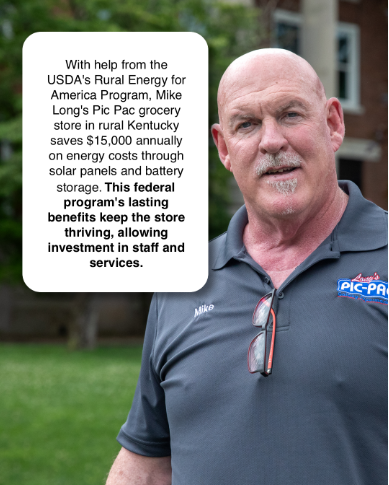
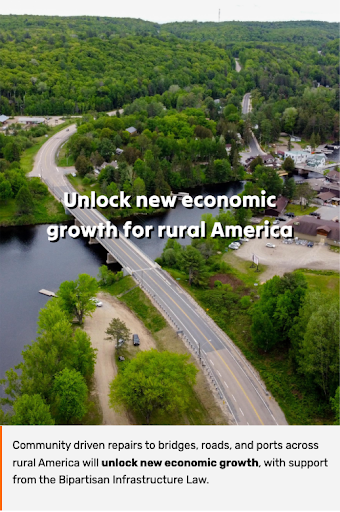
Examples of two of the tested messages.
Key Findings and Take-Aways
1) No run-away winners: In neither of our A/B tests was one of our messages clearly superior to the other. In other words, those who saw the Economic Growth message answered about the same as those who saw the Economic Stability message; and Lasting Benefits did about the same as Risk of Loss. So the testing doesn’t provide clear guidance that one of the messaging approaches is consistently better in either match-ups than the other.
- Takeaway: Don’t sweat the small stuff. One way to interpret these results is that the relatively modest wording differences between the test messages may not have been dramatic enough to move the needle, especially when promoting already-popular policies, such as support rural communities, which received solid majority support even among those who saw the placebo.
2) We can reach rural folks: When compared against the placebos, Resource Rural’s messages in aggregate increased support for federal rural funding by approximately 6 percentage points. This persuasion effect from these samples of their content suggests that their broader field campaign has the potential for impact among rural audiences.
3) Accentuate the positive? The messages that may be viewed as more ‘optimistic’ (centering policy upsides and potential new economic growth) were clearly better than placebo at increasing support for federal rural funding. The messages that may be viewed as more ‘pessimistic’ (premised on risk of loss, or safeguarding the status quo) had weaker statistical evidence that they increased support.
- Takeaway: Positive messaging in rural communities isn’t the losing battle that some expect. These results (and merely the fact that the ‘pessimistic’ messages were not obvious top performers) is notable because it pushes back against some conventional wisdom that and classic social science concepts (such as loss aversion) that suggest that negative framing may be more effective (for example, efforts to repeal Obamacare increased support for it). But it aligns with other studies that find talk of losing a desirable policy to be unpersuasive while the possibility of policy gains spurred activism (see our review), and thus provides useful new evidence in this ongoing debate over best practice.
What’s Next
Resource Rural and the Climate Advocacy Lab are planning to do further testing to examine other design messaging design choices, including comparisons between “hard work” vs. “innovation”; “future generations” vs. “immediate impact”; and “jobs created” vs. “community benefits”. Further tests might also explore the effect of different messengers and graphic types.
Resources
- Resource Rural’s messaging framework owes a debt to formative research by the Rural Climate Partnership, which in turn draws on the Winning Jobs Narrative project. They have also been inspired by the research of social scientist Emily Diamond.
- Interested in message testing with the Lab? Whether you’re just getting started with creating your stories and messages, or want to test your messages before they go out in the field, our Lab team is here to support you through our Field Research Program. Reach out to Social Scientist, Justin Rolfe-Redding to get started.
Appendix: Message Evaluation Survey Questions
Below are the survey questions participants saw after the messages. See the full experiment setup and questions’ response options for the Benefits/Loss test and Growth/Stability test.
Test #1: Growth vs. Stability
- Do you support or oppose federal funding for rural areas?
- To what extent do you agree or disagree with the following statement: Infrastructure repairs will improve economic opportunities in my area.
- The federal Bipartisan Infrastructure Law has provided funding to improve rural highways, expand broadband internet, and strengthen local water systems.
Test #2: Benefits vs. Loss
- Do you support or oppose federal funding for rural areas?
- To what extent do you agree or disagree with the following statement: Federal funding will improve opportunities for small businesses in my area.
- The USDA’s Rural Energy for America Program provides grants to farmers and rural small businesses for renewable energy and energy efficiency upgrades. Do you support or oppose keeping the USDA’s Rural Energy for America Program?
- What words and phrases come to mind after reading this message?