Organizing local support for clean energy projects – January 2025
Author: KyungSun Lee, Climate Advocacy Lab
January 10, 2025
Community Perceptions & Values in New York
State-wide organizing is a challenging undertaking, especially in a place as diverse and vast as New York. New York Renews (NYR), a diverse coalition of 3,000 members fighting for equitable and just climate solutions, partnered with the Lab to build persuasive messaging that would help grow and activate their base. The first step to enact this messaging strategy was to understand regional differences in how people perceive clean energy, just transition, and climate justice focused solutions that mirrored the benefits from the Inflation Reduction Act. Using online Audience Understanding Surveys in Grow Progress as qualitative listening tools, NYR received a baseline understanding of the core values, attitudes, and perceptions of people in five regions: Capital/Mid-Hudson, Long Island, NYC, and Western NY.
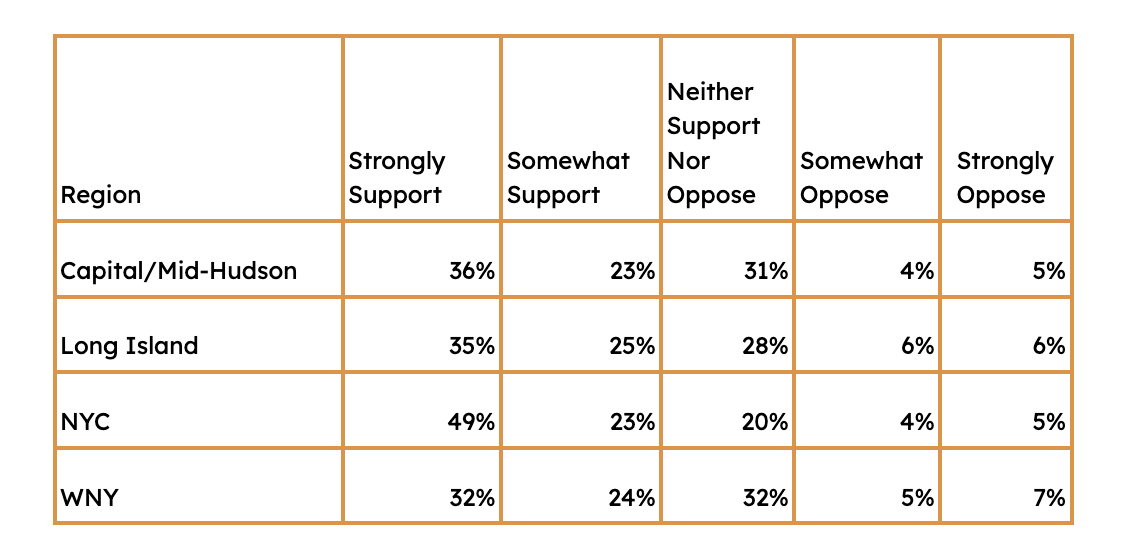
Where do people stand on equitable solutions? It’s one thing for people to support clean energy solutions in their state. One of the key questions NYR wanted to answer was whether people supported or opposed efforts to ensure a portion of state and federal funds for clean energy targeted toward lower income communities and people of color. While we saw a wide range of support, the overall data shows that there is a pathway to build support of equitable clean energy solutions.
We also uncovered patriotism, reputation, and tradition are key motivators for people who are likely to support clean energy solutions, and live outside of New York City. While these are not typical sentiments we lean into in our communications, they’re opportunities for new inroads across regions. We also need to continue to explore support on other issues that intersect with our work including the economy, immigration and healthcare.
If you’re interested in using Audience Understanding Surveys for your persuasive messaging work, connect with us!
Lessons from Climate Deep Canvass in Maine & New Jersey
Next, we share another pathway to building persuasive messaging: deep canvassing. People’s Action Institute is a national network of local and state power-building organizations in 29 states. As a multi-issue organization, they have been at the forefront of building and iterating deep canvassing as an effective tactic for basebuilding and persuasion.
In 2022, they found that deep canvassing was a promising tactic for climate action, particularly in areas where more conventional campaigning was likely to fail due to opposition. This year, they decided to support deep canvass projects in two states with growing opposition to offshore wind development, Maine & New Jersey. People’s Action Institute’s member organizations, the New Jersey Resource Project (NJRP) and Maine People’s Resource Center (MPRC), designed, led and executed the work, with deep coaching from the New Conversation Initiative.
NJRP’s goal was to use deep canvassing as a social listening tool to better understand the positions of residents in Lacey Township, New Jersey on the development of offshore wind, while bolstering community support for such developments. They had 344 conversations across 2.5 months.
Similarly, MPRC’s goal was to persuade and build community support for siting the offshore wind port on Sears Island. They had 1,082 conversations over 4.5 months with residents in coastal Maine communities within 25 miles of Sears Island. Some highlights on what we found from both projects are:
Train canvassers how to listen without jumping into debunking, debating, and persuasion. When canvassers iterated their script to lead with a space of acceptance and openness, they were then more effectively able to build inroads to persuasion, such as talking about how an offshore wind project can be an economic opportunity to fill in funding gaps and help the community prosper.
Community Benefit Agreements can be an effective entry point when it comes to clean energy infrastructure development, providing a tangible and powerful means for local communities to win positive outcomes. By hearing residents’ concerns, it was clear most felt a lack of agency over policies that affected them. Canvassers therefore talked about how other communities have used CBAs to negotiate with developers to obtain local benefits which attracted interest in offshore wind projects.
How do these lessons resonate with your deep canvasing work? Share your thoughts with us. And stay tuned for a more detailed report on these climate canvass projects by Lab Social Scientist, Jack Zhou in 2025.
Thank you to contributing writers Jack Zhou & Kate McKenney on this Hub report, with feedback from Sophia Cheng at People’s Action Institute, and the teams at New Jersey Resource Project and Maine People’s Resource Center.
Partner with us to build evidence-based messaging & organizing strategies
As we prepare for the year ahead, partner with us to build evidence-based organizing, messaging, and narrative strategies for an equitable and just clean energy transition as part of our Field Research Program. Whether you’re trying to blend online and offline organizing tactics, wanting to understand the attitudes and values of your potential base, or build/test messages that work, our Lab team is here to support you. Connect with KyungSun, our Senior Program Manager to learn more.