UPDATED FOR THE SECOND EDITION!
Why do some coalitions for climate action seem to work well while others fall apart? What does it mean for a coalition to produce not only successful outcomes but operate via healthy processes? And how can traditional environmental organizations find not only common ground but common ways of working across sectors with environmental justice, labor, racial justice, and other types of advocates?
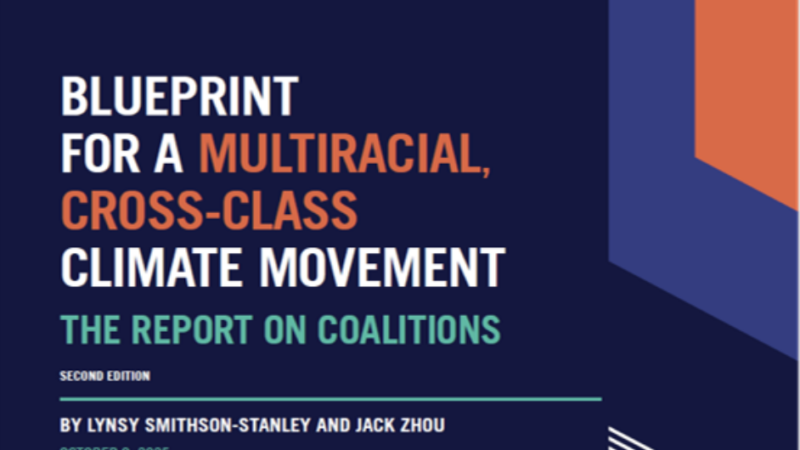
To answer these questions, the Climate Advocacy Lab has developed a Blueprint to analyze and break down how climate advocates can most effectively set up and work in the multiracial, cross-class (MRXC) coalitions that are essential to winning the intersectional policies needed to address the climate crisis. We intend for our "Blueprint for a MRXC Climate Movement" to help the U.S. climate community build more equitable, durable coalitions that are also more effective in delivering and wielding political power. While not all campaigns and coalitions can win, our hope is that they fall short only due to external circumstances and not due to miscommunication or a lack of attention to healthy internal process.
Our Blueprint is made up of two complementary pieces:
The Report on Coalitions presents our research findings from a combination of case study analysis and direct interviews with climate organizers and movement leaders. We start with a review of how various popular organizing models define the principles and components (i.e., “variables”) that lead to strong, powerful climate organizing, and identify them according to their purported necessity in successful coalition practices. These variables include considerations of resource-sharing, mutual accountability, strategic planning, conflict management, and internal flexibility. We analyze how these variables show up in practice when looking at five recent cases of climate campaigns that we believe illustrate a breadth of outcomes and processes in MRXC climate coalitions: Illinois’ Climate and Equitable Jobs Act, the fight against the Line 3 pipeline in Minnesota, New York’s Community Leadership and Community Protection Act, the Portland Clean Energy Fund, and Washington state's I-1631 ballot initiative. We supplement these case studies with dozens of interviews, trainings, convenings, coaching sessions with coalition
facilitators.
We distill our findings into 19 recommendations that cover Shaping the Coalition, Ways to Work Together, Staying Aligned, and How to Keep Growing.
The Workbook for Coalitions takes those 19 recommendations and transforms them into specific and applicable discussion prompts for motivated coalition members to share with their collaborators. These conversation-starters dig deep into the underlying questions and processes that, based on our analysis, often make or break MRXC climate coalitions. By openly talking about these concepts – in the process surfacing peoples' opinions and making explicit their underlying assumptions – we believe that participants will be better prepared to structure their MRXC climate coalitions and overcome the external and internal barriers that may come their way.
Updated for the Second Edition with:
- A new overarching framework based around Strategic Culture
- Clarification on the purpose and limitations of subgroups in coalition governance and decision-making
- A closer look at the role of funders and how they can impact coalition leadership
- Expanded guidance around conflict management and intervention frameworks
- Theory-crafting about coalition outcomes, or what happens at the end of a coalition’s animating campaign
- Guidance on how to set appropriate containers for conversations with coalition partners that are both productive and psychologically safe.
- Updated exercises for greater clarity and specificity
- A collection of additional resources for facilitators, including links to various conflict management frameworks that we reference throughout the Blueprint
These two documents will be supported through additional outreach opportunities like webinars, trainings, and other programming. Check out our Trainings page or contact us at info@climateadvocacylab.org for more information
Related programming
APPLY NOW by 1/16/26 for the Blueprint Training 2026 Cohort
Watch the recording from our 2025 Second Edition launch event: Blueprint 2.0: New Lessons for Climate Coalitions
Watch the recording from our 2023 launch event: Blueprint for a Multiracial, Cross-Class Climate Movement
Recordings from our Spring 2024 Blueprint training series