Resources
Search below for resources covering the intersection of climate engagement, social science and data analytics.
RESULTS
The Climate Cabinet Scorecard
The Climate Cabinet Scorecard is the first national tool to hold state legislators accountable for their votes on climate and environmental justice legislation. This Scorecard can equip organizations, lawmakers, voters, and journalists with the facts and trends needed to assess how state governments are approaching the fight against climate change – or lack thereof. Voters can discover how over 4,200 state legislators in 27 U.S. states voted on over 475 critical climate and environmental justice bills – including their own state representatives.
How Natural Disasters Can Change A Politician
Politicians who experience climate disasters can become more supportive of climate policy. One research paper found that politicians who experienced climate disasters were more likely to push for climate policies regardless of party. However, a different study that showed abnormal temperature and precipitation trends were correlated with representatives’ environmental votes found that the politicians’ party did matter: Moderate Democrats made the biggest shift toward more environmental-policy support (Republicans did not shift much, nor did more “strident” Democrats, who are already very supportive of climate policy).
Congressional Climate Camp #3: Lessons Learned from Past Congresses and Current Attitudes on Climate
The Environmental and Energy Study Institute brought together a variety of leaders and stakeholders together to examine past legislative efforts and future opportunities to act on and initiate climate policy. Panelists highlighted how big legislative wins, like the Clean Air Act, were critical turning points for environmental policy. But at the same time, policies that aren't ultimately enacted into law—like the Clean Power Plan—can still be instrumental in illustrating the role that policy can and should have in tackling climate issues. Experts in community engagement highlighted how these policies are much more effective when multiple stakeholders are engaged in the process. Broad stakeholder engagement often means looking for bipartisan support. For some political actors, bipartisan collaboration can seem like “bad politics.” In reality, however, it can actually lead to some of the most successful and lasting policies. One panelist even points out that there is little evidence that candidates are punished in the polls for compromising while working on bipartisan efforts.
Clean buses for New York kids
A 2021 report from Jobs Move to America argues that a quick transition to electric school buses in New York City would not only reduce greenhouse gas emissions and create cleaner air environments for kids – the move would also create jobs in the city. The report details some key recommendations for achieving these benefits. First, it would require the creation and funding of pilot program and city-wide mandate to transition to electric buses. Then, at the state level, the report recommends securing job improvements for manufacturing and creating a long-term funding source for electric school buses. Advocates interested in supporting moves to electric school buses should consider these recommendations in their own advocacy efforts.
Climate activism and its effects
Synthesis of research on the specific ways citizens have engaged civically around the issue of climate change and documented effects of these efforts on climate change itself suggests:
- Behavior-change campaigns can positively influence lifestyle choices that reduce their individual carbon footprints, such as reducing car-use, purchase renewable electricity, and eating less meat
- An increasing number of environmental NGOs is associated with lower levels of environmental degradation (including reduced carbon dioxide emissions)
- "Insufficient evidence" regarding what legal challenges/litigation have had on greenhouse gas emissions
- Targeting the economic sector and specific businesses (through boycotts, divestment campaigns, etc.) has resulted in "notable" emissions reductions
Lessons from NYC’s Williams Pipeline battle
A multi-racial coalition focused on organizing and escalating tactics helped defeat the Williams Pipeline: The Stop the Williams Pipeline coalition won by building, organizing, and activating a large and intense base of opposition targeted at the key decision-maker, Governor Andrew Cuomo.
Resilient Clean Energy for California
This report documents the widespread impacts of power shutoffs in California and the drawbacks of conventional solutions. Vote Solar documents the risks of relying on dirty BUGs, including deaths from carbon monoxide poisoning, hazardous air pollution, and, ironically, fire hazards.
Webinar: Centering Equity in Climate Adaptation and Resilience –– with Asian Pacific Environmental Network and The Greenlining Institute
This conversation highlights findings from two reports focused on how the climate advocacy community can support equitable climate resilience (the ability of communities to adapt and thrive in the face of impacts from climate change) in climate policies and programs, as advocates nationwide are pushed to think beyond a frame of "simply" climate mitigation: Making Equity Real in Climate Adaptation and Community Resilience Policies and Programs: A Guidebook and Mapping Resilience: A Blueprint for Thriving in the Face of Climate Disasters.
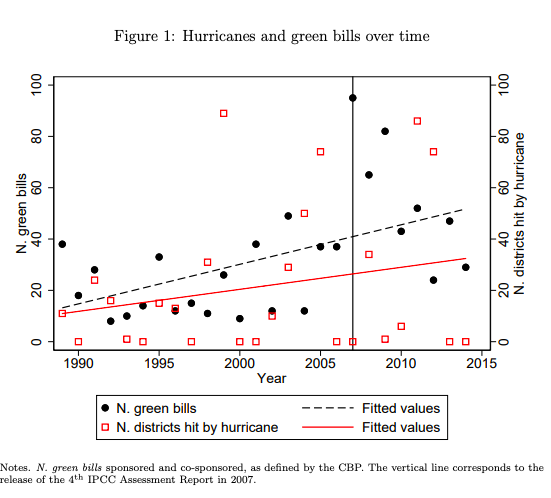
Hurricanes, Climate Change Policies and Electoral Accountability
When climate disasters hit, politicians representing those places may become more concerned about climate change. This resource documents that congress members from districts hit by a hurricane are more likely to support bills promoting more environmental regulation and control in the year after the disaster. The change in legislative behavior by these members of congress is persistent over time, and it is associated with an electoral penalty in the following elections. Further, this effect mainly happens among legislators who are from safe districts (i.e., less likely to face a strong general election challenger in the next election), those with more experience, and those with strong pro-environment records.
The Political Power of Protest: Minority Activism and Shifts in Public Policy
Gillion’s research examines whether a protest can make a real change – and the short answer is that it does. Looking at the effect of civil rights protests from the 1960’s–1990’s on Congress, he found that protest had a small but detectable effect on legislators. And he identified factors that increased the salience of a protest to politicians.
Pagination
- Previous page
- Page 2
- Next page