Resources
Search below for resources covering the intersection of climate engagement, social science and data analytics.
Latest Resources
How's IRA doing?
Is the Inflation Reduction Act, passed nearly two years ago, doing what it set out to do? In this episode, Trevor Houser of the Rhodium Group compares the predictions of pre-IRA energy-sector models to the real-world data on clean-energy investment since its passage.

Environmental Polling Roundup - March 8th, 2024
This post includes climate and environment headlines, data points, and key takeaways from recent public polls - including new polling on climate change as an issue in the presidential election, new polling on the Inflation Reduction Act, and new polling on EPA standards for particle pollution and vehicle emissions.
HEADLINES
Climate Power
Unlocking Clean Energy Incentives for Underserved Communities
The Inflation Reduction Act provides an unprecedented opportunity to foster more equitable participation in clean energy development and channel resources into historically marginalized communities. Because of the IRA’s Direct Pay provision, nonprofits, and state, local, and Tribal governments can now access tax credits over 10 years for clean energy projects in underserved communities. This democratizes energy, unlocking the potential for diverse entities across the U.S. to own clean energy assets as a wealth-building opportunity.
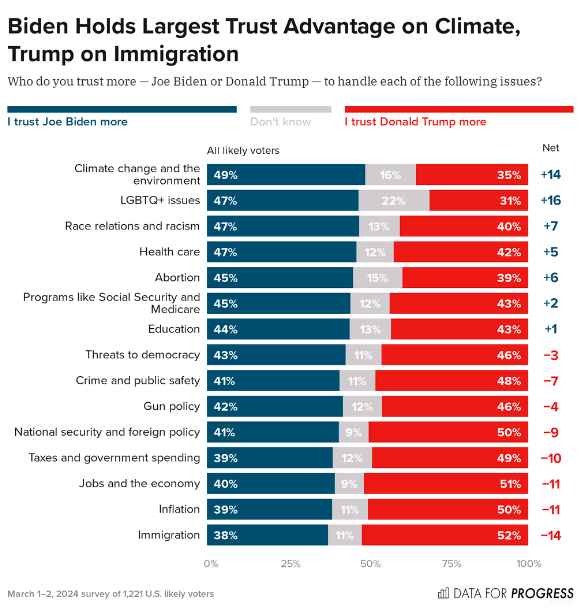
Climate and the environment rank among President Biden’s largest issue advantages over Trump. 76% of voters support protecting the environment and addressing climate change, including 47% who “strongly” support it. 75% of voters support investing in clean energy technologies, including 43% who “strongly” support it.
Poll: Americans Remain Pessimistic on the Economy and Personal Finances
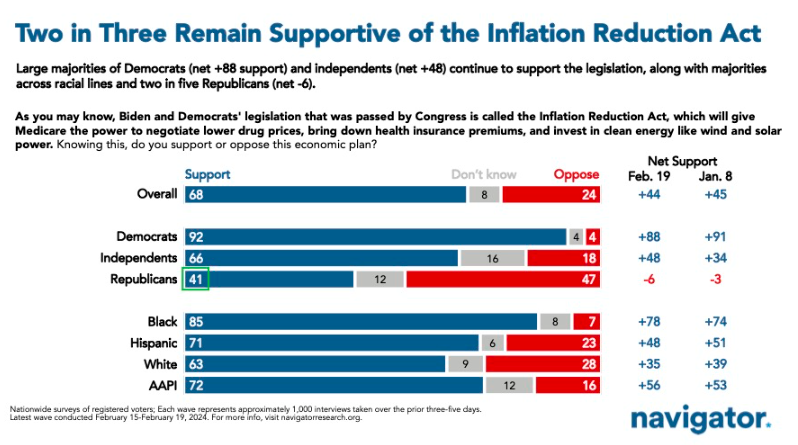
Voters continue to support the Inflation Reduction Act by a wide margin after learning about it. Voters support the Inflation Reduction Act by a nearly three-to-one margin (68% support / 24% oppose) after reading a brief, one-sentence description of it. And while voters consistently say that they support the IRA, it would be a mistake to assume that they know much about it: polling has consistently found that awareness of the law lags far behind support for it.
New Poll Shows 7 in 10 Voters Support EPA Action to Clean Up Truck Pollution
Voters overwhelmingly support stronger EPA standards for particle pollution and heavy-duty vehicle emissions. 78% of voters support the EPA setting stricter limits on fine particles, also called “soot,” that power plants, oil refineries, and other industrial facilities can release. 82% of voters support the EPA setting stricter limits on mercury and other toxic air emissions from power plants. 78% of voters support the EPA setting stricter limits on smog from power plants, oil refineries, and other industrial facilities.

Environmental Polling Roundup - March 1st, 2024
This post includes climate and environment headlines, data points, and key takeaways from recent public polls - including new polling on polluter accountability, new message testing about pausing liquefied natural gas (LNG) export projects, and newly released state-level polling on carbon dioxide removal (CDR).
HEADLINES
Poll: Voters Strongly Support Key Policies That Would Deter Oil and Gas Companies From Illegally Polluting
Voters overwhelmingly want stronger accountability for polluters, including compensation for damages to the environment and local communities. Most disapprove of the court decision to block an investigation of environmental injustices in Louisiana’s “Cancer Alley”.
Poll: Voters Across Four States Show Broad Support for Clean Energy, Carbon Removal
Voters widely support carbon dioxide removal (CDR) projects in key states where they are being considered, and see improved air quality as the clearest benefit of these projects. While voters aren’t very familiar with CDR, they are inclined to feel positively about the technology. In Wyoming, for example, NWF and Data for Progress find that 57% of voters feel favorably about “carbon dioxide removal technologies” when the term is first introduced in the survey while only 16% have unfavorable attitudes about the term.
Messy Conversations: How to Talk to Kids about Climate Change, with Mary Annaïse Heglar
How should we talk to kids about climate change? The world is beautiful, but the world is changing—and you can play a part in the change. Mary Annaïse Heglar's first book is out today, and it's a children's book about climate change. It's the first of three climate books Mary has coming out in the near future (the other two are a novel, called Troubled Waters, and an essay collection of Black writers on climate). She has been busy writing up a storm since we wrapped up Hot Take (and we've roped her into editing stories for Drilled, too).